
INSIDER SESSION
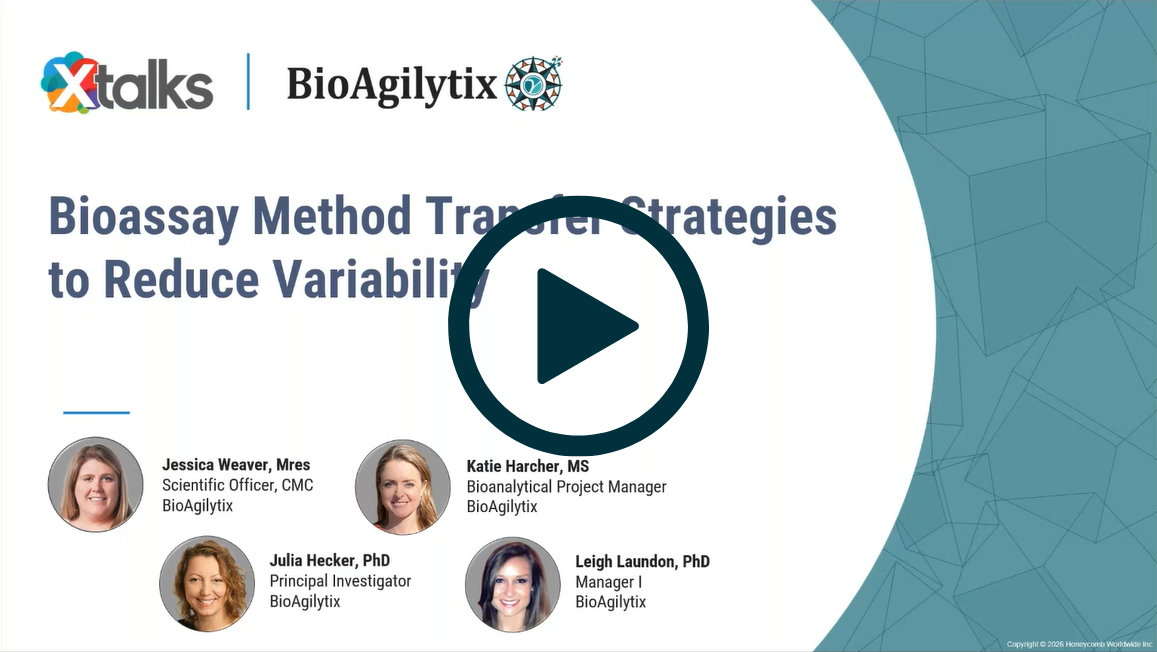
Bioassay Method Transfer Strategies to Reduce Variability

Bioassay variability can pose significant challenges due to laboratory conditions, instrumentation, analytical software, cell culture performance, and reagent sourcing. These inconsistencies can impact assay reproducibility, data integrity, and regulatory compliance, ultimately affecting product quality and potency assessments. This webinar will highlight phase-appropriate strategies that balance flexibility in early development with the rigour required for late-phase validation, ensuring method consistency.
Recent guidance from regulators emphasizes bioassays and potency assurance strategies, underscoring the robustness of these assays and their ability to be moved across multiple locations throughout product development.
The method transfer involves relocating a bioanalytical procedure from one laboratory environment, often a development or research lab, to another, such as a quality control lab, a contract research organization or back to the innovator’s lab. The FDA and EMA emphasize documentation, robust comparability studies, and risk-based approaches to method validation. The aim is to ensure the method performs consistently across sites to maintain product quality, potency, and comparability throughout the product lifecycle. This emphasizes the development of robust processes and a strong understanding of their critical attributes.
Key strategies for mitigating variability include:
- Reproducibility and Robustness: Demonstrate the assay yields compatible results across laboratories
- Documentation: Thorough records of the method, the assay performance and modifications
- Risk Assessment: Identifying critical assay parameters and implementing controls and procedures to mitigate risk
- Critical Attributes: Often identified through acceptance criteria but may include technique, reagents and details
- Phase Appropriate Considerations: The rigor of assay transfer and validation typically escalates as a product moves from early-phase clinical development toward commercialization
Our experts will discuss lessons learned from their experiences and offer insight into the multiple stages of specific assays including critical reagents, regulatory standards, assay formats and timelines.
- Jessica Weaver, MRes, Scientific Officer, CMC
- Katie Harcher, MS, Scientific Operations
- Julia Hecker, PhD, Principal Investigator
- Leigh Laundon, PhD, Scientific Operations
Share this Resource


